
Risk Cycles
April Commentary
Seven weeks after the outbreak of the US/Israel – Iran war on February 28, we are seeing cooler heads prevail among global leaders. With less uncertainty about the duration of the war, the markets seemed to appreciate this. The US S&P 500 Index posted new highs of 7,022 on April 15. Brent crude oil futures have pulled back from its high of $118 to $96. BTC is now trading around $74,000, about 10% above its February month-end price, and ETH now around $2,300, a 13% gain over the same month and a half period. To properly assess the market’s potential, it’s important to keep in perspective that risks and opportunities occur in cycles. And quantum risk just appeared on the horizon.
The Perfect Storm, in Hindsight
When we think about cycles in investing, quite often we think about the economic cycle of growth, inflation, and interest rates. For the crypto markets, the four-year bull-bear cycle is popular theme. Although many have attributed this to Bitcoin halving, it probably should be better attributed to the product development and liquidity cycles.
However, there are other forces that introduce uncertainty into the markets. These forces also have their cycles. There’s a discovery, a developmental period, maturity, and resolution (or a transition to a new state). Depending on the event in question, these cycles will occur over different durations.
Unlike the neatly drawn sine waves we see in math class, progress through real-life cycles is messy with an unknown periodicity or duration. For the crypto markets, we probably saw the negative confluence of many of these forces at the end of February. Namely,
Nascent recovery in derivatives volume after the massive crypto de-leverage of October 10, 2025, triggered by the China-US spat over rare earth restrictions and subsequent tariffs;
Uncertainty over the direction of future interest rates after US President Trump’s nomination of Kevin Warsh to the Federal Reserve, followed by the further derivatives de-leveraging on February 5;
Uncertainty over the progress of the CLARITY Act in the US Senate;
And finally, the outbreak of the US/Israel – Iran war.
Opportunities certainly have their cycles as well, but for the crypto markets, these are manifesting over longer horizons. Positive developments include the expanding use of stablecoins, broadening of crypto ETF and derivative products, use of blockchain technology to upgrade the current financial market infrastructure, and tokenization of real-world assets (RWAs). Progress has been less noticeable as the work has been on the plumbing, which is under the surface. News on this work certainly has been less sensational compared to the shorter cycle events.
No Rest for the Weary – The Quantum Risk Cycle
On March 30, 2026, two papers dropped like twin grenades. Google Quantum AI showed that a future quantum machine with under 500,000 qubits could derive a Bitcoin private key in nine minutes. Oratomic and Caltech proved the same attack could run on just 10,000–26,000 qubits. While the US National Institute of Standards and Technology’s guidance is to complete post-quantum migration by 2030/2035, both Google and Cloudflare accelerated their own deadlines to 2029. The Ethereum Foundation also aims to complete its layer-1 protocol upgrades by 2029. Surprisingly, the Bitcoin community is still debating without any consensus.
To be clear, this “future quantum machine” is theoretical. However, as the Quantum Computing Report noted, these breakthroughs mean one thing: the safest course for the entire crypto industry is to “begin preparing itself against quantum attacks immediately.”
Ethereum vs. Bitcoin – Different Strokes for Different Folks
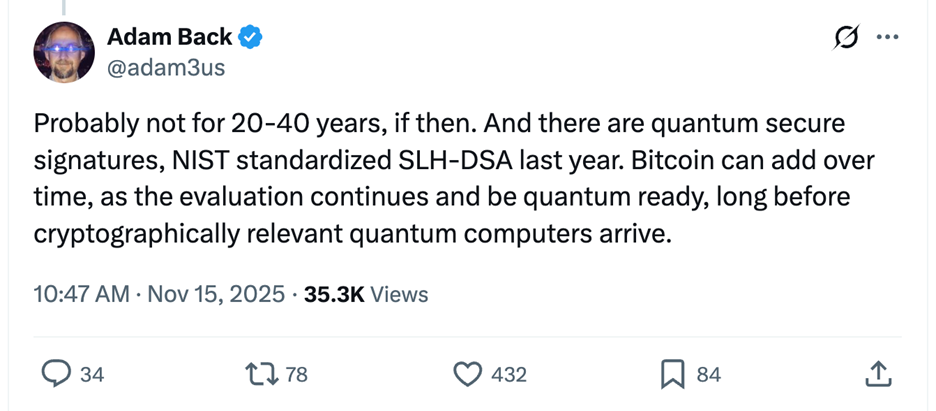
Bitcoin’s core developers have long treated the quantum threat as a distant, theoretical problem rather than something requiring urgent action. Influential voices such as Peter Wuille, Adam Back, and Peter Todd have downplayed the urgency. They often dismiss it as fearmongering or claim the real risk is still 20 to 40 years away.
Source: x.com
This challenge is made even harder by Bitcoin’s upgrade history. The network has not undergone any successful hard-fork protocol changes on its main chain since its launch in 2009. All contentious hard forks — like Bitcoin Cash and Bitcoin Gold in 2017 — simply created separate blockchains and new altcoins rather than upgrading the original Bitcoin network. Instead, Bitcoin has relied exclusively on three backward-compatible soft forks: P2SH in 2012, SegWit in 2017, and Taproot in 2021. However, hard forks are widely considered necessary for Bitcoin to become fully quantum safe. We highlight the fact that Bitcoin’s slower 10-minute block time makes it especially vulnerable.
In contrast, Ethereum is taking a completely different approach. The community has long embraced rapid innovation. It has repeatedly shown that it can execute complex network upgrades quickly and smoothly. Since 2015, Ethereum has successfully completed over 20 hard forks, including the landmark Merge in 2022, all without disrupting users or losing funds.
The Ethereum Foundation has discussed its quantum strategies publicly since 2019. Its official post-quantum roadmap sets an ambitious but realistic target: full quantum safety on the main network by 2029. That timeline lines up with Google’s own aggressive 2029 deadline. Testnets are already running, and development teams are actively testing new post-quantum signature methods.
The difference in approach between these two chains are stark enough that Etherealize, a platform focused on the Ethereum blockchain infrastructure research and development, has conjectured whether ETH deserves a “quantum-readiness” premium.
Report Card on the Risk Cycles
The recent lift in BTC, ETH, and other altcoin token prices feels like the crypto market is forming a support level around the near-term bottoms. If we were to qualitatively assess the quality of the various cycles, this would be our report card.
The recent ceasefire in the US/Israel – Iran war is still tentative. The Strait of Hormuz is not freely opened, supply routes are disrupted, oil prices border close to $100 per barrel, all of which point to a risk of higher inflation and interest expectations, accompanied by lower liquidity. We are cautious about the durability of the ceasefire. If it doesn’t hold, expect volatility to return to the market.
We are reportedly seeing positive compromise over stablecoin yields that have thus stalled the progress of the CLARITY Act through the Senate Banking Committee. This is optimistic.
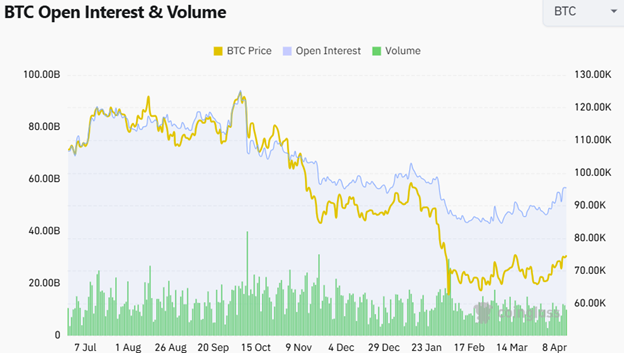
The crypto futures market trades multiples over the spot volume. Volume is returning but appears to be tentative. Quite likely, volume is a coincidental indicator. This metric suggests caution.
Source: Coinglass
The longer horizon progress on blockchain, stablecoin, and DeFi adoption and RWA tokenization of real-world assets are decidedly positive. However, recent reports on the quantum computing risk introduced a new risk factor that ought to be closely watched over the next 3 – 5 years. As investors, we now need to consider the quantum-readiness risk into our asset selection and portfolio construction process.