
Decentralization Demands Diversity
April Commentary
After struggling in the first quarter of 2026, the crypto-market seemed to have found its footing at the beginning of this second quarter. BTC built a base around $70,000 earlier in April and closed above $76,000 by month-end. The broader market, as measured by the Bitwise Large Cap Crypto Index, gained just under 11% in April. Quality remains an important feature of asset selection (honestly, when is it not?), and April brought some sharp reminders, as it became the worst month for crypto exploits since February 2025 with over $606 million lost across just 12 incidents in the first 18 days alone. Two primary breaches captured the bulk of the losses, the KelpDAO ($290 million) and Drift Protocol ($285 million) attacks. We think client diversity is yet another quality feature that investors ought to consider when selecting digital asset tokens.
Client Diversity and Network Resilience
With the emergence of models like Anthropic’s Claude Mythos Preview, AI agents have demonstrated an unprecedented ability to identify and exploit vulnerabilities in operating systems and blockchain protocols in just hours. These agents can independently chain minor software bugs into major exploits. This ability significantly reduces the time developers have to patch critical software and decentralized protocols.
This faster threat era turns client diversity into a mandatory security requirement. In a public blockchain, a node is an individual computer that maintains the network. The client is the software that the node runs to follow the protocol rules. While mainstream operating systems like Windows or macOS only have one implementation, public blockchains can have many. If a network relies on only one software version, a single AI discovered bug can lead to total network failure or the loss of transaction finality for every node on the system.
Multiple independent client implementations provide network resilience. Because these clients are written by different teams in different programming languages, they rarely share the same flaws. If one client is compromised by an AI driven exploit, the remaining nodes running different clients continue to validate and produce blocks. This prevents network failure.
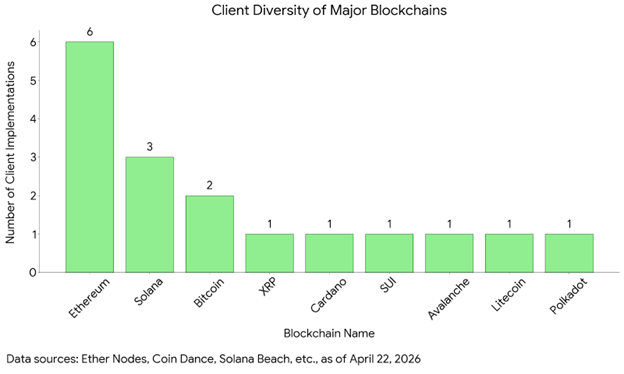
Ethereum currently leads the industry in this metric. As shown in the above chart, Ethereum maintains the highest number of production ready clients. No single consensus client holds a supermajority that could threaten the integrity of the chain. For comparison, Bitcoin and Solana not only have fewer client implementations, but their largest clients control a supermajority of their nodes. The Bitcoin Core client controls 77% of all Bitcoin nodes, while the Agave client is running on over 85% of Solana validator nodes. While other networks are still working toward higher decentralization, the distributed architecture of Ethereum remains the industry standard for resisting automated cyber-attacks.
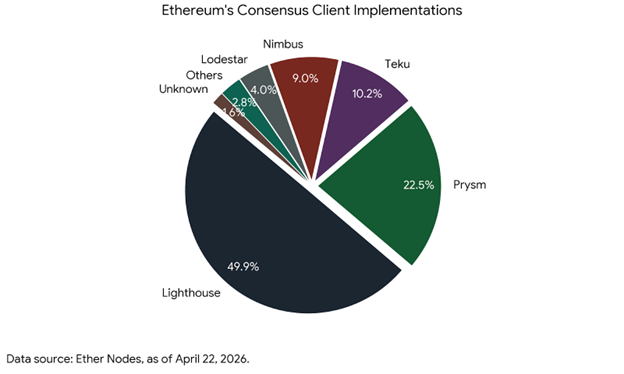
As AI models become more intelligent, blockchains need to embrace diverse and independent protocol implementations to enhance network resilience. At Firinne Capital, we believe that network resilience to AI and quantum computing threats are critical in protecting long term network value.