
Know Yourself
November Commentary
“Know your enemy and know yourself; in one hundred battles you will never be in peril” – Sun Tzu, Art of War
November’s market volatility has left many investors battle weary. The Bitwise 10 Large Cap Crypto Index pulled back 18% in November, and close to -6% YTD. 2025 was supposed to be the year of tailwinds – supportive new US administration, favorable legislation, institutional adoption, tokenization of RWAs. If these factors haven’t been driving the market, then what have?
Misplaced Expectations
It’s hard to keep focused on these slower, long-term developments when short-term dynamics seem to be driving investor activity. The crypto-market appears to be still reeling from the October 10 crash that liquidated $19 billion in leveraged positions over the day. This was compounded by the Democratic wins in the US November 2025 elections. Together, investors haven’t seemed to have regained their confidence. CoinMarketCap’s Greed & Fear index has persistently remained in the Fear and Extreme Fear territory over the past month.
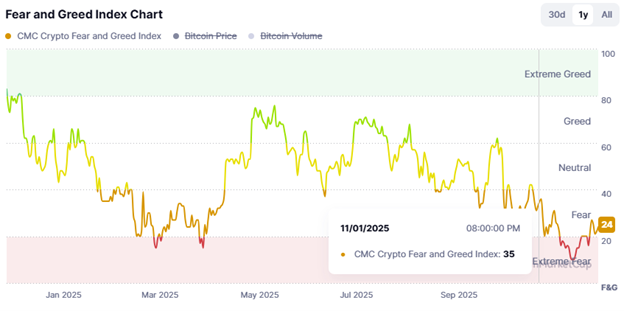
Source: CoinMarketCap
The US government shutdown for a record-breaking 43 days ending on November 12 did not do the market any favors either. The US economy slowed (the government wasn’t spending), and employment and inflation data with which to judge interest rate policy were missing, both leaving the market uncertain. Over this shutdown period, the aspirational narrative of BTC being a digital version of gold did not hold up to scrutiny. BTC dropped 11% while gold gained about 8%. Indeed, year-to-date, correlations tell us that BTC is acting more like technology stocks although the narrative of BTC being a digital safe-haven currency may yet play out in the long run.
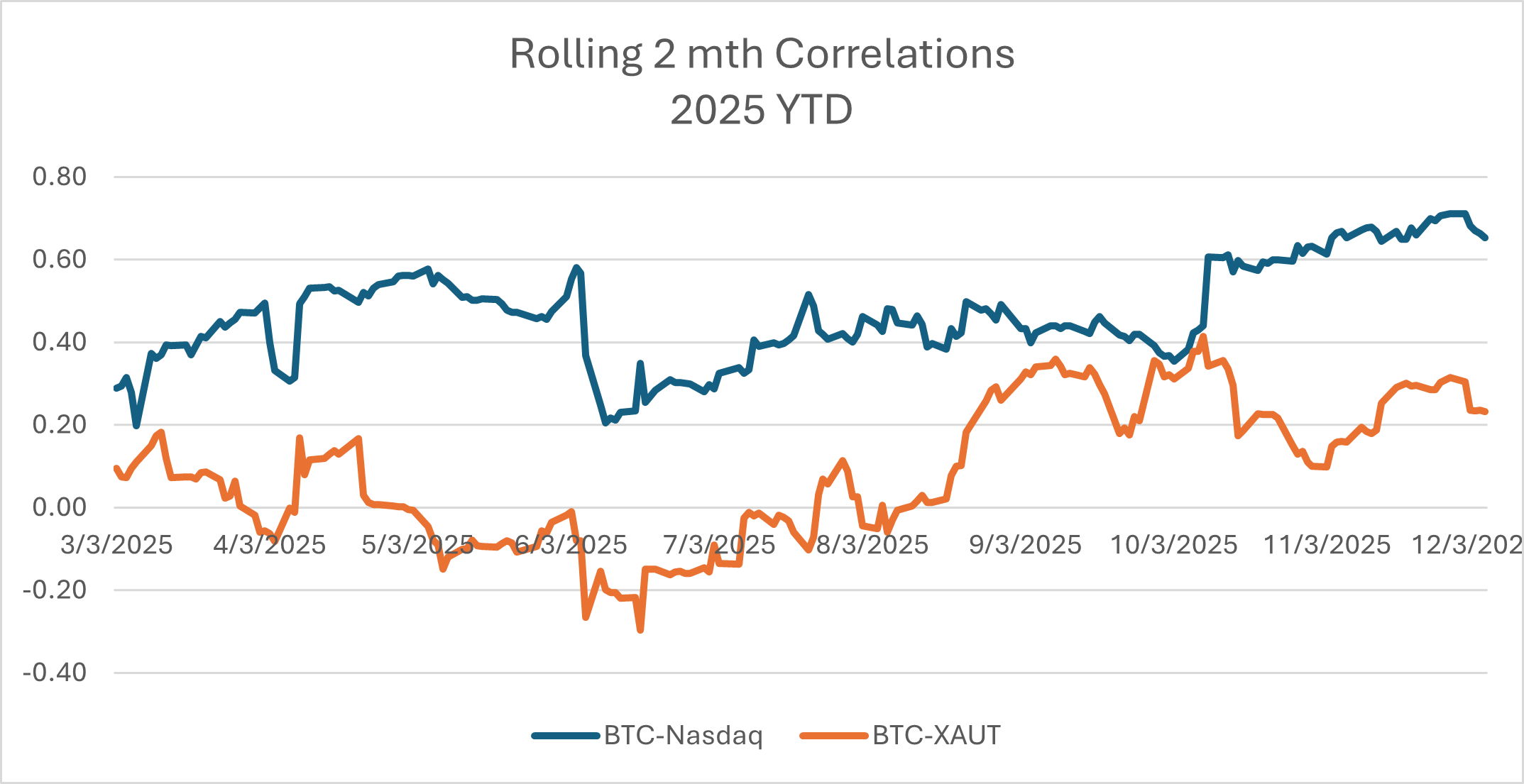
XAUT is Tether-Gold, a token pegged to gold prices and is used in this analysis as a proxy for the underlying commodity. Sources: Nasdaq, Coingecko, Firinne Capital.
Investors are therefore turning to the Fed. With the US government re-opening and economic data flowing again, the Fed delivered a 25 bps rate cut on December 10 to target its Fed Funds rate to a range of 3.50% to 3.75%. Lower rates and improved market liquidity should be a boost to risk and long-duration assets, but the crypto-markets haven’t reacted as positively as one may hope for. Perhaps this is due to the concerns that liquidity may not be as abundantly available as suggested simply by the US policy rates. One indicator to watch is the spread of the Secured Overnight Financing Rate (SOFR) versus the Effective Fed Funds (FF) rate. SOFR should generally be equivalent to the FF rate given that these are rates that price repurchase agreements (repos) secured by US Treasury. However, since President Trump’s announcement of tariffs on China in early October, the SOFR-FF spread has remained persistently positive, hinting at lingering stresses in the credit system.
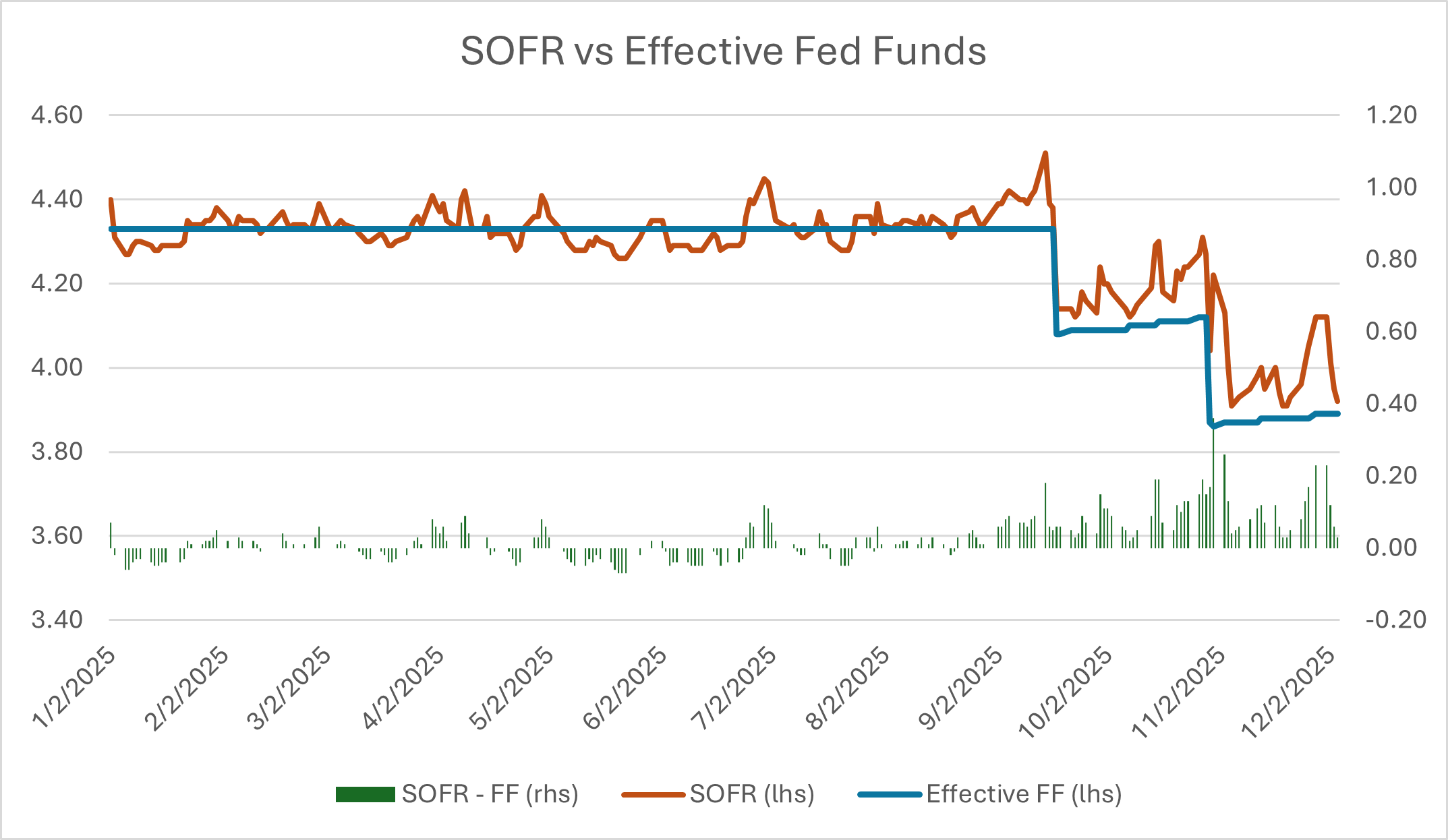
Source: FRED, Firinne Capital
Additionally, Japanese Government Bond yields have been rising to a level not seen over the last 17 years. This hints at rising Japan inflation which would force the Japanese Central Bank to raise short term rates, which would also curtail global liquidity. More importantly, one only needs to look back to August 2024 to see how damaging rising Japanese short rates are to the unwind of the global carry trade and market stability.
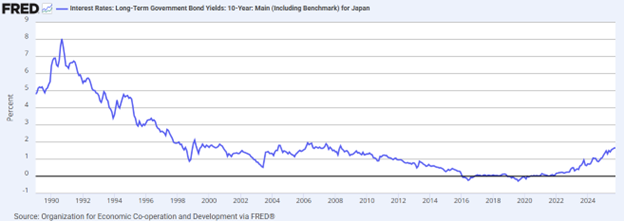
Source: OECD, FRED
Looking Forward
Markets will go about their short- to mid-term tantrums but aren’t the tailwinds for the crypto-market and ecosystem still in play? Well, yes, they are and there’s plenty to look forward to.
With the US government re-opening, the SEC Chair Paul Atkins said that the agency can move forward with its crypto “innovation exemption” despite the CLARITY Act still being stalled in the US Senate. Separately, in a nod to recognizing past government policies were not conducive for crypto-platform development, the US House Committee on Financial Services recently released its investigation into Operation Chokepoint 2.0. Together, this is a strong acknowledgement of a positive seismic shift in political attitudes to blockchain and the crypto-markets.
On-chain, Ethereum just underwent a major upgrade bundle on December 3 known as Fusaka. Among the various improvements, a couple are worth highlighting. EIP-7594 introduces Peer Data Availability Sampling (PeerDAS) to improve scalability. Rather than requiring nodes to download entire "blobs" of data, this improvement allows nodes to sample approximately just an eighth of the full dataset, relying on statistical probability rather than brute-force storage to ensure data integrity across the network. EIP-7918 addresses a market failure in pricing data blobs (off-chain data used by Layer 2’s that are not being accessed by the EVM while the data commitments are being accessed). Transacting on the Ethereum chain requires data and execution. Both were being priced independently of each other. This EIP establishes a floor "reserve price" that ties the minimum blob fee to the Layer 1 execution fee, ensuring data costs can no longer be decoupled from network activity and that Layer 2s pay a fair market rate for using the Ethereum chain’s computational resources and security.
The following day, Figure (Nasdaq: FIGR), an on-chain platform for the origination and trading of on-chain loans and tokenized real-world assets (RWAs), announced the launch of the RWA Consortium that partners with other crypto native platforms including Chainlink (oracle) and Kamino Finance (on-chain lending) among others to expand access to Figure’s Prime token on Solana. Efforts like this improve blockchain interoperability and expand DeFi access to financial products that are underpinned by RWAs.
One Hundred Battles
With so many factors, drivers, and metrics to consider, how should an investor incorporate all these disparate signals? This is when, as an investor, it is paramount to understand your goals. What type of returns are you seeking, over what time horizon? What events are possible, probable, or inevitable and what conviction do you have in making your investments? What risks are you willing to tolerate? What signposts will you track to see whether developments are confirming your investment thesis? The enemy is the market, the variety of agents trading for their own utility, and perhaps your own biases. Having clarity of investment purpose is critical for success.
At Firinne Capital, our investment horizons are medium to long-term, from six months to a full crypto market cycle. We remain firm in our conviction that blockchain and on-chain apps will be the future technology rails of the global financial system, and that we’re still in the early innings of adoption and application. This conviction reduces our investment universe to a small subset of the tens of thousands of tokens readily available for trading. Many of these tokens exhibit strong network effects, growing value being locked on-chain, and rising number of participants and transactions. These are the tailwinds that guide our conviction and give us the confidence to weather market volatility. Building a portfolio that will be resilient during market downturns while still being positioned for the rallies that will unexpectedly and inevitably arise is the challenge we signed up for.